In the hospital data, falls from tree stands hurt more deer hunters than guns do. Almost half happen climbing up or down, the injuries are mostly spines, and in two of the studies not one injured hunter wore a harness.
Hunter education spends hours on firearm safety, and it works: gun accidents are rare. The studies of hunters who end up in a hospital point at something else. Falls from tree stands are the injury that keeps showing up, and they are often serious.
More hunters hurt by stands than by guns
A CDC report on Georgia deer hunters from 1979 to 1989 counted 594 deer-hunting injuries; 214 of them, 36 percent, were tree-stand related, and 17 of those were fatal. A study of 130 injured hunters at two Ohio trauma centers over ten years found half the injuries were falls, and 92 percent of those falls were from tree stands; its authors titled it “Tree stands, not guns, are the midwestern hunter’s most dangerous weapon.”
Almost half fall climbing up or down
In the Georgia report, 52 percent fell from the stand itself, 23 percent while climbing down and 19 percent while climbing up. A stand or its parts failed in 32 percent of the incidents, and 5 percent of the injured hunters said they had fallen asleep.

See the numbers
| When | Hunters | Share |
|---|---|---|
| Fell from the stand | 111 | 52% |
| Climbing down | 49 | 23% |
| Climbing up | 40 | 19% |
The injuries are mostly spines
In the Ohio study, 59 percent of the hunters who fell broke their spine, 18 percent had a head injury, 81 percent needed surgery and 8.2 percent were left with lasting nerve damage. A Wisconsin hospital study of 117 tree-stand falls from 1999 to 2013 found 65 hunters with spine fractures and 10 spinal cord injuries. In an Oklahoma study of 16 hunters with spinal cord injuries or deaths after falls, nearly 90 percent of the injuries left them partly or fully paralyzed.

See the numbers
| Outcome | Share of fall victims |
|---|---|
| Needed surgery | 81% |
| Spine fracture | 59% |
| Head injury | 18% |
| Lasting nerve damage | 8.2% |
The harness is the difference
None of the 214 injured Georgia hunters was wearing a safety harness or a seat-belt device, and none of the 16 Oklahoma hunters was using a safety restraint. A full-body harness, worn and attached, turns a fall into a hang.

The habits that prevent a fall
- Wear a full-body harness every time, and attach it before your feet leave the ground. A lifeline from the base of the tree to above the stand, with a sliding knot clipped to the harness, keeps you attached on the climb up and down, when almost half the Georgia falls happened.
- Three points of contact. Two hands and a foot, or two feet and a hand, on every step.
- Haul the gun or bow up on a rope, unloaded, after you are in the stand. Lower it the same way.
- Check the stand every season. Straps, chains, cables and steps wear out; a third of the Georgia falls involved a failed part.
- Stay awake, or stay tied. Sitting before dawn after a short night is when hunters doze off. A harness tether keeps you in the tree if you do.
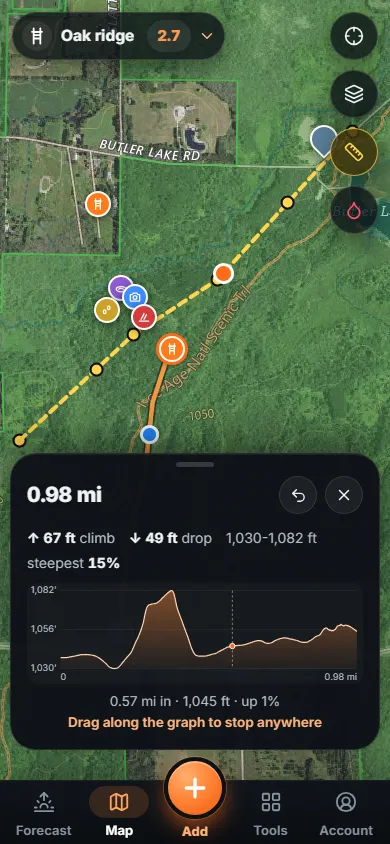
- Tell someone where you are. Mark the stand on your phone and share it; carry the phone on you, not in the pack on the ground.
Sources: Centers for Disease Control. Tree stand-related injuries among deer hunters - Georgia, 1979-1989. Morbidity and Mortality Weekly Report. Crockett, A. et al. 2010. Tree stands, not guns, are the midwestern hunter’s most dangerous weapon. The American Surgeon 76(9). Hamilton, S. et al. 2017. Tree stand falls (University of Wisconsin Hospital, 1999-2013). WMJ 116(4). Stubbs, J. et al. 2004. Journal of the Oklahoma State Medical Association 97(4).
By state
Photo: see credits. Questions or a correction? Write to us.