A deer at 15 yards feels like the easy shot. It is the one that surprises people: the bullet is below the crosshair, the angle from a stand is steep, and a little movement is enough to put the shot in the wrong place.
Most deer killed with a rifle in the woods are shot well inside 100 yards, and plenty at 15 or 20. Up close the shot looks simple, but three things work against you that do not matter much farther out: the bullet starts below your scope, the angle from a tree stand gets steep fast, and a deer that takes one step changes where the bullet lands. None of them is hard once you know the numbers.
The numbers in this post are worked out from basic physics for one example: a 150-grain bullet leaving the barrel at 2,820 feet per second, a scope 1.5 inches above the bore, the rifle zeroed at 100 yards. Your rifle and load will differ a little; the pattern will not.
Up close, the bullet is below the crosshair
Your scope sits above the barrel, so the bullet starts out below the line you are looking along. To meet the crosshair at 100 yards the barrel points slightly up, and the bullet climbs toward the line of sight, crosses it, and comes back to it at your zero. Inside about 50 yards it has not caught up yet: in our example it hits 1.3 inches low at 5 yards, 1.1 inches low at 10 and about two thirds of an inch low at 25.

See the numbers
| Distance | Bullet vs crosshair | Speed | Energy |
|---|---|---|---|
| 5 yd | 1.3 in low | 2,807 ft/s | 2,625 ft-lb |
| 10 yd | 1.1 in low | 2,795 ft/s | 2,602 ft-lb |
| 25 yd | 0.7 in low | 2,758 ft/s | 2,533 ft-lb |
| 50 yd | 0.1 in low | 2,697 ft/s | 2,423 ft-lb |
| 75 yd | 0.1 in high | 2,638 ft/s | 2,317 ft-lb |
| 100 yd | on the crosshair | 2,580 ft/s | 2,217 ft-lb |
| 150 yd | 1.3 in low | 2,468 ft/s | 2,028 ft-lb |
| 200 yd | 4.2 in low | 2,360 ft/s | 1,855 ft-lb |
An inch matters less than it sounds: a deer’s heart and lungs are a target several times that size. What it means in practice is simple. Up close, put the crosshair where you want the bullet, not low on the chest. A hunter who aims at the bottom of the vitals on a close deer is giving away an inch he does not have.
The angle from a tree stand gets steep fast
From 20 feet up, a deer 30 yards out is only 11 degrees below you. Halve the distance and the angle doubles; at 10 yards it is 30 degrees, and a deer that walks under the stand at 5 yards is nearly 50 degrees down. The bullet travels through the deer at that angle, not level.

See the numbers
| Deer out | Angle down |
|---|---|
| 5 yd | 49° |
| 10 yd | 30° |
| 15 yd | 21° |
| 20 yd | 16° |
| 30 yd | 11° |
| 40 yd | 8° |
Aim for where the bullet comes out
On a level shot the bullet goes in and out at about the same height. On a steep shot it goes in high and comes out low. If you hold on the usual broadside spot from straight above, the bullet can pass under the far lung and out the brisket. The fix taught in hunter education is to think about the exit: pick the spot on the far side you want the bullet to leave through, low in the far-side chest, and aim so the line runs there. In practice that means holding a little higher on the near side than you would at the same deer on the ground.

The steeper the angle, the more this matters, and the smaller the window gets. A deer straight under the stand shows you its spine and little else; that is a shot to pass. Let it take a few steps out.
Faster, and harder on the bullet
Up close the bullet hits at almost the speed it left the barrel: in our example 2,795 feet per second at 10 yards against 2,580 at 100. That extra speed is the top of the range most hunting bullets are built for. Bullet makers state the impact speeds each bullet is meant to expand at, and a bullet made to open up at long range can come apart fast at very close range. If most of your shots are inside 50 yards, read the box for the speed range your bullet is made for and pick one built for close, fast hits.
A walking deer moves more than you think
A bullet is fast, but not instant. In our example it needs about 27 thousandths of a second to cover 25 yards and 54 to cover 50. A deer walking at about 3 miles an hour covers 4.4 feet in a second, so in that time it moves 1.4 inches at 25 yards and 2.9 inches at 50. That is enough to move a shot from the heart into the back of the lungs. A deer trotting at 20 miles an hour moves nearly 10 inches before a bullet reaches it at 25 yards.
| Deer out | Bullet time | Walking deer moves (3 mph) | Trotting deer moves (20 mph) |
|---|---|---|---|
| 25 yd | 27 ms | 1.4 in | 9.5 in |
| 50 yd | 54 ms | 2.9 in | 19 in |
| 100 yd | 111 ms | 5.9 in | 39 in |
The cleanest answer is the old one: stop the deer. A soft grunt or a short whistle stops most walking deer for a second or two, long enough to shoot a still animal. Have the rifle up and the crosshair on the deer before you make the sound.
Close-range habits that help
- Turn the scope down. A scope on its lowest power shows you a wider piece of the woods, so a close deer is easier to find in it and you can see what is behind it. Leave it on low in thick cover and turn it up only when you need to.
- Know what is behind the deer. At 15 yards from a stand, the ground behind the deer is close; at a level shot it can be a long way off. Every hunter-education course says the same thing: be sure of your target and what is beyond it.
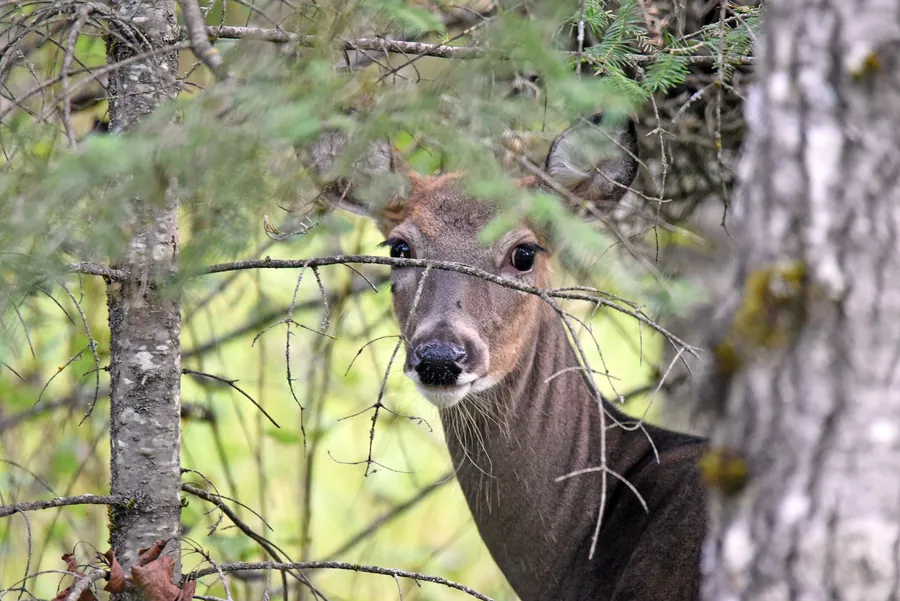
- Mind the brush. Up close you see the deer through branches you would never notice at 100 yards. A twig in the first few feet of a bullet’s path can turn it. Find a clear lane, or wait for the deer to step into one.
- Practice the close shot. Shoot at 15 and 25 yards before the season, from the stand height and the sitting position you will use, so you see for yourself where your rifle hits.
By state
Photo: see credits. Questions or a correction? Write to us.